Showing posts with label SPM. Show all posts

Saturday, 24 April 2021

SPM Biology 4 Chemical Composition of the Cell Part 5 Organic Compounds in the Cell - Nucleic Acids

1. Macromolecules containing carbon, hydrogen, oxygen, nitrogen, and phosphorus.

2. The building blocks (monomers) of nucleic acids are called nucleotides.

3. Each nucleotide consists of three parts:

  • A 5-carbon sugar or pentose
  • A phosphate group
  • A nitrogenous base

Structure of nucleotide

4. 2 types of pentose sugars

  • ribose
  • deoxyribose


5. Nitrogenous base

  • adenine (A)
  • guanine (G)
  • cytosine (C)
  • thymine (T)
  • uracil (U)

6. Importance: store & transmit hereditary (genetic) information.

7. There are 2 types of nucleic acids:

  • Deoxyribonucleic acid (DNA)
  • Ribonucleic acid (RNA)


Deoxyribonucleic acid (DNA)

1. DNA contains deoxyribose sugar. 

2. Nitrogenous base groups for DNA - A, T, G, C

3. Consists of 2 polynucleotide strands twisted around each other in the form of a double helix.

4. DNA is found in the nucleus, mitochondrion & chloroplast.

5. Importance: carries the genetic code; to store genetic information


Ribonucleic acid (RNA)

1. RNA contains ribose sugar.

2. Nitrogenous bas groups for RNA - A, U, G, C

3. Consists of single-stranded polynucleotide chain, shorter than DNA.

4. RNA is found in nucleus & cytoplasm.

5. 3 types of RNA:

  • messenger RNA (mRNA)
  • ribosomal RNA (rRNA)
  • transfer RNA (tRNA)

6. Importance: involve in protein synthesis

DNA and RNA structures
RNA and DNA structures

Formation of chromosomes


Formation of chromosomes

Monday, 19 April 2021

SPM Biology 4 Chemical Composition of the Cell Part 4 Organic Compounds in the Cell - Lipids

1. Contain carbon, hydrogen, oxygen.

2. Proportion of oxygen is lower than in carbohydrates. For example: stearic acid C18H36O2.

3. Insoluble in water (non-polar molecule), but dissolve in other lipids and non-polar solvents (ether, ethanol, etc.).

4. Four main types of lipids:

  • Fats and oils (triglycerides)
  • Waxes
  • Phospholipids
  • Steroids

5. Importance:

  • Store large amount of energy
  • Sources of energy
  • A major part of the structure of cell membranes


Fats and Oils (triglycerides)

Fats and oils
Fats and oils


1. Fats are solid at room temperature (20ºC).

2. Oils are liquid.

3. Triglyceride is formed from a condensation reaction between 1 molecule of glycerol and 3 molecules of fatty acids. The bonds formed are called ester bonds.

Formation of triglyceride


4. Fats often contain only saturated fatty acid (single bond).

5. Oils usually contain unsaturated fatty acid (double bond).

Diagrammatic representation of fats


Structure of saturated and unsaturated fats


6. Importance of fats and oil:

  • Function as energy reserve & storage materials. They provide 38kJ per gram, while carbohydrates provide only 17kJ per gram.
  • Fats act as an insulator against the loss of heat. 

7. Types of fats

Similarities and differences of saturated fat and unsaturated fat


Waxes

1. Similar to triglycerides.

2. Produced by both plants & animals.

3. Usually hard solids at room temperature.

Waxes
Waxes


4. Importance of waxes:

  • Used to waterproof the external surfaces of plants & animals. E.g: cuticle of leaf, protective covering on an insect’s body.
  • Also a constituent of the honeycomb of bees.


Phospholipids

  • Major component of plasma membranes
  • Made up of 1 glycerol, 2 fatty acid and 1 phosphate

See SPM Biology 3 Movement of Substances Across the Plasma Membrane Part 1 Structure of Plasma Membrane


Steroids

1. Complex ring structure. Do not contain fatty acids.

2. Occur in plants and animals.

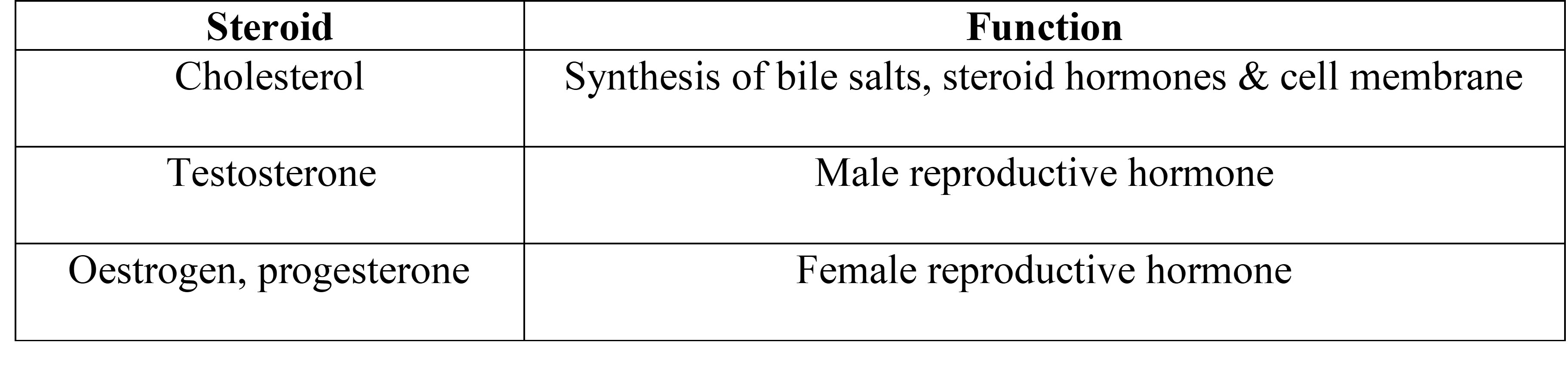
3. Examples: 

Steroids
Steroids


Sunday, 11 April 2021

SPM Biology 4 Chemical Composition of the Cell Part 3 Organic Compounds in the Cell - Proteins

Food that contain protein

1. Consists of carbon, hydrogen, oxygen and nitrogen.

2. Sometime Sulphur and phosphorus may be present in some protein.

3. All proteins are made up of subunits called amino acids.

4. Each amino acid carries 2 functional groups:

  • carboxyl group (-COOH)
  • amino group (-NH2)

Amino acids basic structures

5. Human need 20 types of amino acids to synthesize proteins.

6. 2 amino acids can combine to form a dipeptide by condensation reaction.

condensation reaction

7. Long chains of amino acids are called polypeptides.

8. Proteins act as enzymes, hormones, antibodies, etc.

9. Changes in pH, temperature and salt concentration can cause proteins to lose their shapes and functions. This process is known as denaturation.

10. Importance:

  • as building blocks of many structural components of the cell.
  • form enzymes, hormones and antibodies.


Types of amino acids

The 20 amino acids needed by humans can be divided into 2 groups:

(a) Essential amino acids (11)

  • cannot be synthesized by human body.
  • for examples: leucine, lysine, histidine.

(b) Non-essential amino acids (9)

  • can be synthesized by human body.
  • for examples: alanine, glutamine, glycine.


Protein structures

There are 4 different structures of protein:


Saturday, 3 April 2021

SPM Biology 4 Chemical Composition of the Cell Part 2 Organic Compounds in the Cell - Carbohydrates

Organic compounds - chemical compounds that contain carbon (C) elements.

Monomers - building blocks for polymers

Polymers - materials made of long, repeating chains of molecules.


Organic Compounds in the Cell - Carbohydrates

Foods that contain carbohydrates

  • Made up of carbon, hydrogen & oxygen
  • Ratio of hydrogen atoms to oxygen atoms in one molecule of carbohydrate is 2:1
  • Importance: as storage and supply of energy
  • 3 main types of carbohydrates: monosaccharides, disaccharides, polysaccharides

3 main types of carbohydrates


Monosaccharides (Simple Sugar)

  • General formula: (CH2O)n , where n = 3 , 5 / 6 carbon atoms in the molecule
  • Most common = 6-carbon sugar / hexoses (C6H12O6)
  • Soluble in water, sweet, and form crystals
  • Can combine with protein & lipids to form glycoproteins & glycolipids (part of plasma membrane)
  • All monosaccharides are reducing sugar!!
  • Examples:

Monosaccharides
Monosaccharides

Disaccharides

  • 2 monosaccharides form disaccharides, by removing a molecule of water (condensation)
  • Formula: C12H22O11
  • It can be broken down to monosaccharides by adding water (hydrolysis)
  • Water soluble, sweet, form crystals
  • Maltose and lactose are reducing sugar, sucrose is not !!
  • Examples:

Disaccharides
Disaccharides


Polysaccharides

  • Polymers that consisting of chains of monosaccharides
  • General formula: (C6H10O5)n , where n varies from 40 to several thousands
  • Can be hydrolyzed to monosaccharides by heating with acid / enzymatic reactions
  • Insoluble in water, ✗ sweet, cannot be crystallized
  • Iodine solution is used to test for the presence of starch
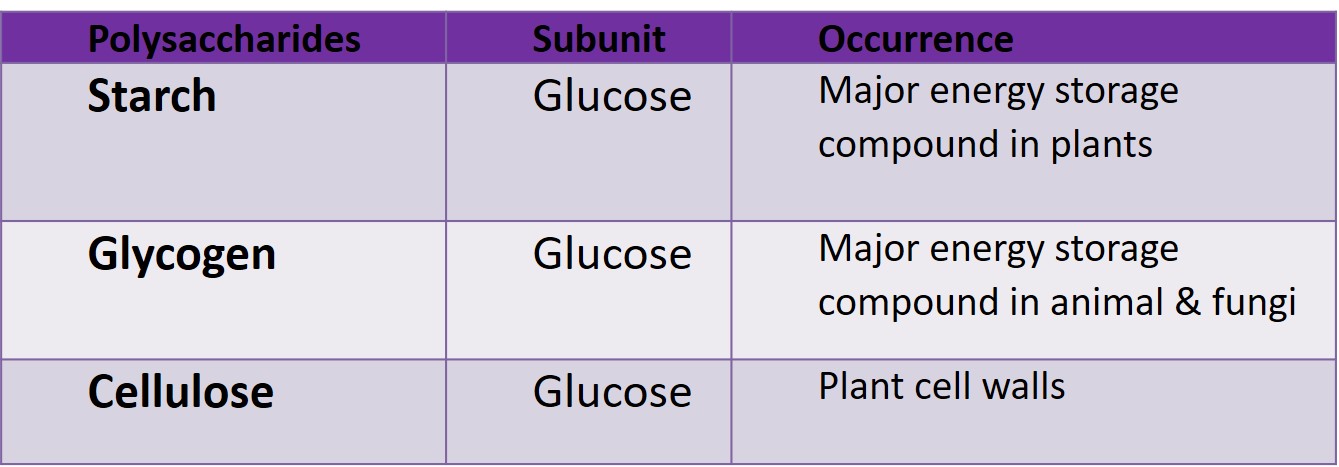
  • Examples:

Polysaccharides
Polysaccharides

Condensation and hydrolysis
Condensation and hydrolysis 


★ Reducing Sugar ★ [Any carbohydrate whose structure contains an aldehyde, or a hemiacetal in equilibrium with an aldehyde]

Define: sugars that can act as reducing agents.

Example of reducing sugar's structure
Examples of reducing sugar's structure

Test for a reducing sugar: Benedict’s solution

  • When sugar solution is heated with Benedict’s solution, formation of a brick-red precipitate indicates a reducing sugar is present.

Benedict`s test
Benedict`s test

SPM Biology 4 Chemical Composition of the Cell Part 1 Inorganic Compounds in the Cell - Water

SPM Biology 4 Mind Map

Properties of water and its importance in a cell

1. Polarity of water

  • Water is inorganic compound.
  • Consist of hydrogen and oxygen elements.
  • Polar molecules - produce hydrogen bonds and allow water to act as universal solvent.
  • Allow solutes such as glucose to be transported into cells.
Structure of water
Structure of water

2. Cohesive force and adhesive force of water

  • Cohesive force: Water molecules are attached to each other.
  • Adhesive force: Water molecules are attached to other surfaces.
  • Both forces produce capillary action (allow water to move along narrow spaces, eg. xylem tube).

3. Specific heat capacity of water 

  • Water has a high specific heat capacity (4.2kJ/kg/°C) - 4.2kJ of heat energy required to raise the temperature of one kg of water by 1°C.
  • Water absorbs a lot of heat energy with a small rise in temperature. This helps to maintain the body temperature of organisms.


Friday, 26 March 2021

SPM Biology 3 Movement of Substances Across the Plasma Membrane Part 3 3 Types of Solution & the Effects of Different Concentrations of Solution on Cells

The direction of movement of substances across the plasma membrane in the cell depends on the concentration of the solution around it.

There are 3 types of solution:
  1. Hypertonic solution = solution with higher concentration of solutes than the cell. (lower water concentration)
  2. Hypotonic solution = solution with lower concentration of solutes than the cell. (higher water concentration)
  3. Isotonic solution = solution with equal solute concentration.
**osmosis happen when the water diffuse across the membrane from hypotonic solution to hypertonic solution***

Three types of solution


In hypertonic solution, red blood cells undergo crenation (water diffuse out from cell, cell shrivel and die). Plant cells undergo plasmolysis (plant cell loses water and shrivels, cell becomes flaccid, cause plant wilt). 

In hypotonic solution, red blood cells undergo hemolysis (the cell gain water and swell, finally burst because they no cell wall). Plant cells become turgid (vacuole gain water, expands and exerts pressure outwards on the cell wall).

In Isotonic solution, water diffuses into and out of the cell by osmosis at the same rate. The cells maintain their normal shape.


***terms hemolysis & crenation only for red blood cell.

Blood condition in different solutions


Saturday, 20 March 2021

SPM Biology 3 Movement of Substances Across the Plasma Membrane Part 2 Passive Transport and Active Transport

The movement of substances across a plasma membrane occurs through Passive Transport and Active Transport


Passive Transport

Definition: The movement of substances across the plasma membrane from a region of high concentration to a region of low concentration (down the concentration gradient).


Characteristics:

1. Do not require energy.

2. Substances move across the plasma membrane through:

  • Phospholipid bilayer
  • Channel protein
  • Carrier protein

3. Three ways of passive transport:

  • Simple diffusion
  • Osmosis
  • Facilitated diffusion


Simple diffusion

1. Definition = the movement of molecules down the concentration gradient until equilibrium is reached.

2. The molecules are evenly distributed with uniform concentration.

3. The bigger the concentration gradient, the faster the rate of diffusion.

4. Soluble substances that can move through phospholipid bilayer as simple diffusion:

  • Small uncharged polar (water soluble) (e.g. oxygen, carbon dioxide, water)
  • Lipid soluble molecules (e.g. fatty acids, glycerol, vitamins A,D,E,K)
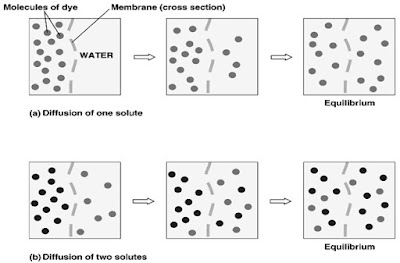
Simple diffusion
Simple diffusion


5. Examples of simple diffusion:

  • Gases exchange at alveolus and blood capillary
  • Gases exchange between body cell and blood capillary


Osmosis (the passive transport of WATER)

1. Definition = the diffusion of water molecules down their concentration gradient through a semi-permeable membrane (selectively permeable membrane).

2. Water molecules move from a region of higher water concentration to region of lower water concentration.

3. Examples: The absorption of water by root hairs of a plant.
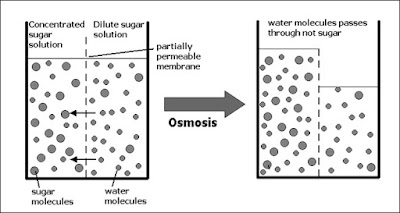
Osmosis
Osmosis


Facilitated diffusion

1. Definition = the passive transport of substances across the phospholipid bilayer with the help of transport proteins (channel protein & carrier protein).

2. The rate of facilitated diffusion depends on:

  • The number of transport protein molecules in the membrane.
  • How fast they can move their specific solute.

3. Substances move through facilitated diffusion:

  • Channel protein: Small charged molecules (e.g. mineral ions).
  • Carrier protein: Uncharged polar molecules (molecules insoluble in fats) (e.g. glucose, amino acid).

4. Mechanism of carrier protein:

The solute moves to the specific binding site of the carrier protein.

The solute binds to the carrier protein at the binding site & triggers the carrier protein to change its shape.

Carrier protein changes its shape and moves the solute across the membrane.

 The carrier protein returns back to its original shape.
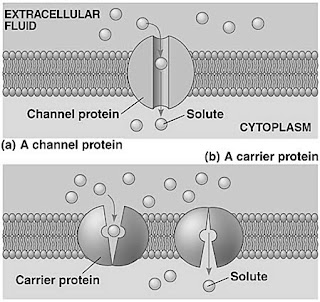

Facilitated diffusion


Active Transport

Definition: the movement of substances across the plasma membrane from a region of low concentration to a region of high concentration (against the concentration gradient).

  • Require Energy (ATP = Adenosine Triphosphate)
  • The transport protein use energy to change the shape of the protein & to pump or transport the substance across the membrane
  • Examples:
    • pumping of sodium ions (Na+) out of the cell
    • intake of mineral ions by the root hairs of a plant
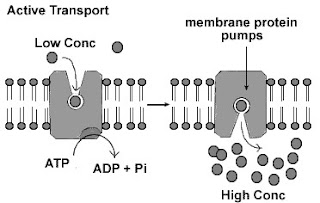
Active Transport
Active Transport


Comparison between Passive Transport & Active Transport


Comparison between Passive Transport & Active Transport

Comparison between Passive Transport & Active Transport


Sunday, 7 March 2021

SPM Biology 3 Movement of Substances Across the Plasma Membrane Part 1 Structure of Plasma Membrane

SPM Biology 3 Movement of Substances Across the Plasma Membrane Mind Map


Need for Movement of Substances Across Membranes

  1. All the substances that are required by the cell (e.g. oxygen, water, mineral) have to be transported from the surroundings across the plasma membrane into the cell.
  2. All the waste products (e.g. carbon dioxide) have to pass through the plasma membrane to be excreted from the cell.


Structure of Plasma Membrane

Fluid Mosaic Model

A membrane is pictured as a mosaic because it has various protein molecules embedded in the phospholipid bilayer. Since the membrane is fluid, most of the individual protein and phospholipid molecules can drift laterally (slow movement away from the normal or original position) in the membrane.


The structure of plasma membrane is comprised of: 

  • Phospholipid bilayer
  • Various types of protein molecules

Fluid Mosaic Model
Fluid Mosaic Model

1. Phospholipid bilayer

  • Is an amphipathic molecules (has both hydrophilic region and hydrophobic region).
  • Polar head: hydrophilic (attracted to water).
  • Non-polar tail: hydrophobic (repelled by water).
  • Only allow some substances to cross the plasma membrane.
  • Small molecules & neutral molecules (e.g. water, oxygen, carbon dioxide, lipid-soluble molecules) can cross the membrane easily.

Phospholipid bilayer


2. Protein molecules

  • Slightly bigger polar molecules (e.g. glucose, amino acids, charged ion) can cross the plasma membrane with the help of protein molecules called transport protein.
  • Transport proteins in the plasma membrane function as:- 
    • Carrier protein: a protein molecule that has a shape that fits the shape of a specific molecules so that it can only carry specific molecules across the membrane.
    • Channel protein: a pore made of protein that provides a passage for a particular solute to pass through.

****Big molecules (e.g. sucrose, protein, starch) cannot move across the membrane****


Saturday, 20 February 2021

SPM Biology 2 Cell Biology & Organization Part 5 Levels of Organization in Multicellular Organisms

Multicellular organisms - Living things with multiple or many cells organized together (eg. animals, plants)


Cell specialization in multicellular organism

  • Cell changes in structure or function in order to carry out a specific function
  • Most of them rely on cooperation of other cells to survive.

Cell organization in multicellular organism

Cells organization
Cells organization

Levels of organization in multicellular organism
Levels of organization in multicellular organism 


Meristematic tissue in plants 


Meristematic tissue in plants
Meristematic tissue in plants 


Organs and systems in plants 

Shoot system - stems, leaves, buds, flower, fruits and etc.

Root system - all roots 

Systems in plants
Systems in plants


Organs in plants
Organs in plants


Notes for plants: 

  • Parenchyma tissue - to store starch, protein and water.
  • Collenchyma tissue - giving support to young, non-woody stems.
  • Sclerenchyma tissue - giving support to mature parts of the plant.

  • Vascular tissue / bundle = xylem tissue + phloem tissue
  • Xylem tissue - transport water and mineral salts from the roots to other parts of the plant,
  • Phloem tissue - transport organic matters (sucrose etc.) from the leaves to all parts of the plant.

Tuesday, 16 February 2021

SPM Biology 2 Cell Biology & Organization Part 4 - Living Processes in Multicellular Organisms

There are various types of cells in multicellular organisms which are different in:
  • size
  • shape
  • arrangement

Each type of cell is specialized to carry out a specific function.


Specialized cells found in humans


White blood cell
White blood cell

1. White blood cell
  • Various shape
  • Function: Destroy pathogen


Red blood cell
Red blood cell
2. Red blood cell
  • X nucleus
  • Shape: biconcave disc
  • Function: Transport oxygen


Epithelial cell
Epithelial cell
 3. Epithelial cell
  • Thin, flat
  • Coats the surface of organs


Muscle cell
Muscle cell
4. Muscle cell
  • Arranged as multinuclear striated fibers
  • Function: Generate movement


Nerve cell
Nerve cell
5. Nerve cell
  • Long, thin
  • Function: Sending nerve impulses


Sperm cell
Sperm cell
6. Sperm cell
  • Has long tail 
  • Head carries chromosomes from the male 


Specialized cells found in plants

Root hair cell
Root hair cell
1. Root hair cell
  • Long
  • Function: Absorb water and mineral salts


Xylem vessel
Xylem vessel
2. Xylem vessel
  • Long, continuous hollow tube
  • Function: Transport water and mineral salts from roots to other parts of the plant


Sieve tube element
Sieve tube element
3. Sieve tube element
  • Long cylindrical tubes
  • Function: Transport organic materials from leaves to storage organs (fruits etc.)


Plant cell
Palisade mesophyll cell & Spongy mesophyll cell

4. Palisade mesophyll cell
  • Long cylindrical cells 
  • Function: Absorb sunlight for photosynthesis 

5. Spongy mesophyll cell 
  • Cells arranged with lots of air space in between
  • Function: Allow gases exchange from inside of the leave to palisade mesophyll cells
Guard cell
Guard cell

6. Guard cell
  • Modified lower epidermal cells with thicker cell wall on inner side
  • Function: Controls opening and closing of stoma (the opening that allows exchange of oxygen and carbon dioxide)