Showing posts with label Lipid. Show all posts

Monday, 19 April 2021

SPM Biology 4 Chemical Composition of the Cell Part 4 Organic Compounds in the Cell - Lipids

1. Contain carbon, hydrogen, oxygen.

2. Proportion of oxygen is lower than in carbohydrates. For example: stearic acid C18H36O2.

3. Insoluble in water (non-polar molecule), but dissolve in other lipids and non-polar solvents (ether, ethanol, etc.).

4. Four main types of lipids:

  • Fats and oils (triglycerides)
  • Waxes
  • Phospholipids
  • Steroids

5. Importance:

  • Store large amount of energy
  • Sources of energy
  • A major part of the structure of cell membranes


Fats and Oils (triglycerides)

Fats and oils
Fats and oils


1. Fats are solid at room temperature (20ºC).

2. Oils are liquid.

3. Triglyceride is formed from a condensation reaction between 1 molecule of glycerol and 3 molecules of fatty acids. The bonds formed are called ester bonds.

Formation of triglyceride


4. Fats often contain only saturated fatty acid (single bond).

5. Oils usually contain unsaturated fatty acid (double bond).

Diagrammatic representation of fats


Structure of saturated and unsaturated fats


6. Importance of fats and oil:

  • Function as energy reserve & storage materials. They provide 38kJ per gram, while carbohydrates provide only 17kJ per gram.
  • Fats act as an insulator against the loss of heat. 

7. Types of fats

Similarities and differences of saturated fat and unsaturated fat


Waxes

1. Similar to triglycerides.

2. Produced by both plants & animals.

3. Usually hard solids at room temperature.

Waxes
Waxes


4. Importance of waxes:

  • Used to waterproof the external surfaces of plants & animals. E.g: cuticle of leaf, protective covering on an insect’s body.
  • Also a constituent of the honeycomb of bees.


Phospholipids

  • Major component of plasma membranes
  • Made up of 1 glycerol, 2 fatty acid and 1 phosphate

See SPM Biology 3 Movement of Substances Across the Plasma Membrane Part 1 Structure of Plasma Membrane


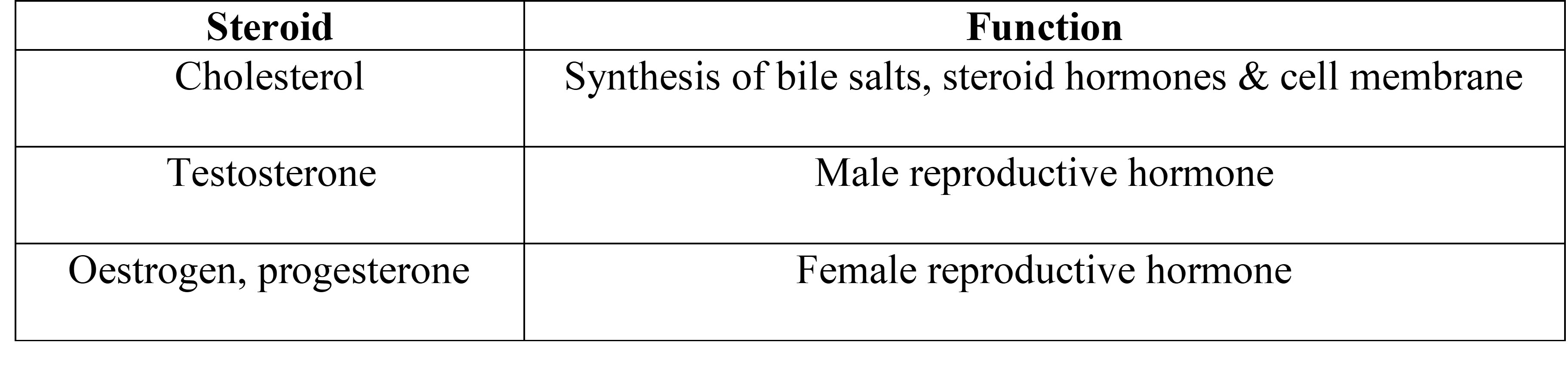
Steroids

1. Complex ring structure. Do not contain fatty acids.

2. Occur in plants and animals.

3. Examples: 
Steroids
Steroids


Monday, 1 March 2021

STPM Biology Biological Molecules Part 10 Lipid - Triglycerides

1. All fats and oils are triglycerides.

2. A triglyceride molecule is formed through condensation reaction between three fatty acids and one glycerol molecule.

3. Hydrolysis of a triglyceride molecule produces fatty acid molecules and glycerol molecule.

Condensation and hydrolysis reactions of triglyceride


4. Each fatty acid molecule is linked to glycerol by an ester bond, -COO. 

Ester bond, -COO
Ester bond, -COO


5. Saturated fat is a fat that does not contain any C=C bond in its molecule. Most of the saturated fat exists as solids in room temperature.

6. Unsaturated fat is a fat that has one or more C=C bonds in its molecule.

  • Monounsaturated fat is fat with molecules that only has one double bond between its carbon atoms. For examples, sesame oil and groundnut oil.
  • Polyunsaturated fat is fat with molecules that have two or more doubles C=C bonds in its molecules. For examples, maize oil, linseed oil and cottonseed oil.
  • Polyunsaturated fat has a low boiling level, thus it exists as liquid in room temperature.

Saturated, monounsaturated and polyunsaturated fat molecules


7. The consumption of food rich with saturated fat and cholesterol increases the risks of cardiovascular diseases. Saturated fat molecules and excess cholesterol deposit on the artery walls, thus narrowing it.


Physical properties of triglycerides

  • Not soluble in water, but soluble in organic solvents.
  • High relative molecular mass.
  • High ratio of hydrogen atoms to oxygen atoms in molecule.
  • Can be emulsified.
  • Fat usually exists as a solid while oil exists as liquid at room temperature.


Chemical properties of triglycerides

  • Triglycerides undergo hydrolysis to form fatty acids and glycerol.


Distribution of triglycerides in organisms

  • In adipose tissues underneath the skin.
  • Attached to the surface of visceral organs such as the heart, liver and digestive tracts.
  • In eggs.
  • In seeds (maize, peanuts and etc.).


Functions of triglycerides

  • Source of energy of organisms.
  • As food and energy stores for animals.
  • Major components of plasma membrane.
  • Heat insulation. Fat underneath the skin is a heat insulator for animals in cold region.
  • Water proofing. Oils and waxes on the outer surface of organisms waterproof the body.
  • Protection. Fats packed around visceral organs protect these organs.
  • Fat is a source of metabolic water for animals.
  • Fat is an important solvent for vitamins A,D,E,K and hormones in the body.
  • Saturated fat is the raw material for synthesizing cholesterol.
  • Buoyancy. Stored fats also aid buoyancy.

Tuesday, 23 February 2021

STPM Biology Biological Molecules Part 9 Lipid

1. Lipid is a compound that contains carbon, hydrogen, and oxygen. But the ratio of hydrogen atoms and oxygen atoms molecules is higher than 2:1.

2. All lipids are formed from fatty acids and glycerol.

3. Glycerol is a type of alcohol known as propane1,2,3-triol. 

4. The structural formula for glycerol:

Glycerol
Glycerol


5. Fatty acid is carboxylic acid with long hydrocarbon chains. Fatty acid differs with the length of the hydrocarbon chain. It can be divided into 2 groups:

  • Saturated fatty acids
  • Unsaturated fatty acids


Saturated Fatty Acids

a. Saturated fatty acid does not have C=C bonds in their molecules.

Saturated fatty acid

b. The common formula for this acid is RCOOH, where R= CnH2n+1 (R= CH3, C2H5...)

c. Examples of saturated fatty acids:

  • Stearic acid
  • Lauric acid
  • Miristic acid
  • Palmitic acid
  • Aracidic acid


Unsaturated Fatty Acids

a. Unsaturated fatty acid has one or more double bonds C=C in the molecules.

Unsaturated fatty acid

b. Example of unsaturated fatty acids:

  • Oleic acid
  • Linoleic acid
  • Linolenic acid
  • Arachidonic acid
  • Palmitoleic acid


6. Non-essential fatty acids are fatty acids that can be synthesized by the body. For examples, oleic acid, stearic acid, cerotic acid and palmitic acid.

7. Essential fatty acids are fatty acids required by the body but are not synthesized by the body. For examples, linolenic acid, linoleic acid, and arachidonic acid. 

8. Lipids are often referred to as alcohol ester because it is formed form acid and alcohol (glycerol).

Structure of alcohol ester

9. Lipids can be classified into 3 major groups:

  • Triglyceride
  • Phospholipid
  • Waxes