Showing posts with label carbohydrates. Show all posts

Saturday, 3 April 2021

SPM Biology 4 Chemical Composition of the Cell Part 2 Organic Compounds in the Cell - Carbohydrates

Organic compounds - chemical compounds that contain carbon (C) elements.

Monomers - building blocks for polymers

Polymers - materials made of long, repeating chains of molecules.


Organic Compounds in the Cell - Carbohydrates

Foods that contain carbohydrates

  • Made up of carbon, hydrogen & oxygen
  • Ratio of hydrogen atoms to oxygen atoms in one molecule of carbohydrate is 2:1
  • Importance: as storage and supply of energy
  • 3 main types of carbohydrates: monosaccharides, disaccharides, polysaccharides

3 main types of carbohydrates


Monosaccharides (Simple Sugar)

  • General formula: (CH2O)n , where n = 3 , 5 / 6 carbon atoms in the molecule
  • Most common = 6-carbon sugar / hexoses (C6H12O6)
  • Soluble in water, sweet, and form crystals
  • Can combine with protein & lipids to form glycoproteins & glycolipids (part of plasma membrane)
  • All monosaccharides are reducing sugar!!
  • Examples:

Monosaccharides
Monosaccharides

Disaccharides

  • 2 monosaccharides form disaccharides, by removing a molecule of water (condensation)
  • Formula: C12H22O11
  • It can be broken down to monosaccharides by adding water (hydrolysis)
  • Water soluble, sweet, form crystals
  • Maltose and lactose are reducing sugar, sucrose is not !!
  • Examples:

Disaccharides
Disaccharides


Polysaccharides

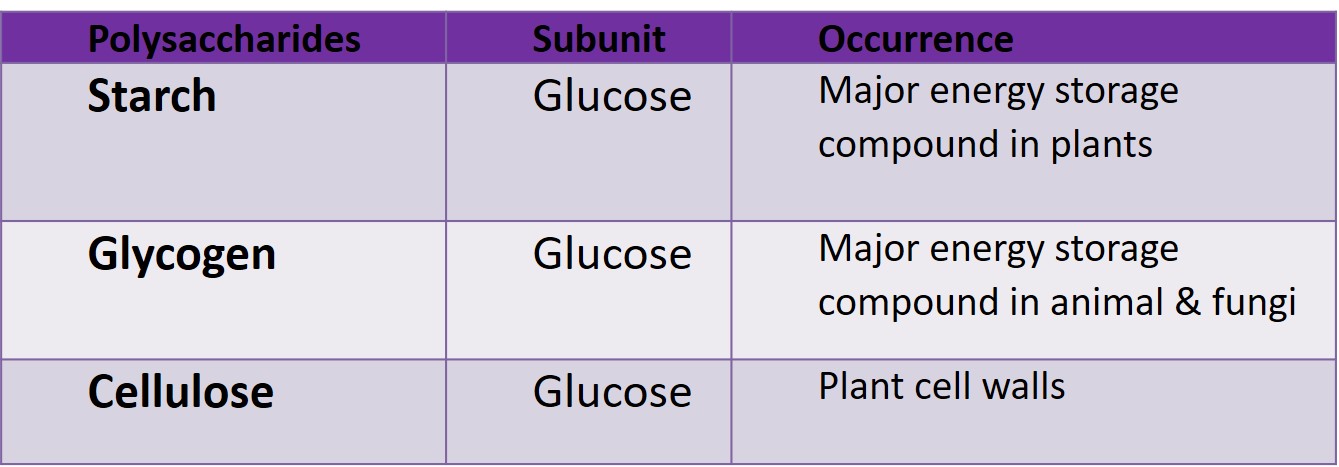
  • Polymers that consisting of chains of monosaccharides
  • General formula: (C6H10O5)n , where n varies from 40 to several thousands
  • Can be hydrolyzed to monosaccharides by heating with acid / enzymatic reactions
  • Insoluble in water, ✗ sweet, cannot be crystallized
  • Iodine solution is used to test for the presence of starch
  • Examples:

Polysaccharides
Polysaccharides

Condensation and hydrolysis
Condensation and hydrolysis 


★ Reducing Sugar ★ [Any carbohydrate whose structure contains an aldehyde, or a hemiacetal in equilibrium with an aldehyde]

Define: sugars that can act as reducing agents.

Example of reducing sugar's structure
Examples of reducing sugar's structure

Test for a reducing sugar: Benedict’s solution

  • When sugar solution is heated with Benedict’s solution, formation of a brick-red precipitate indicates a reducing sugar is present.

Benedict`s test
Benedict`s test

Saturday, 20 February 2021

STPM Biology Biological Molecules Part 8 Carbohydrate - Polysaccharides - Cellulose

1. Distribution:

  • Cellulose is the most common organic materials. It is found in all plant cells. 20% to 50% of the cell wall of plants is cellulose.
  • Also found in cotton (90% cellulose).

2. Physical properties:

  • Not soluble in water.
  • Cannot crystallize.
  • Not sweet.
  • High relative molecular mass.

3. Chemical properties:

  • Can undergo hydrolysis to form β-glucose.
  • Reacts with iodine solution to form brownish-yellow complex.


Structure of Cellulose

1. Cellulose has long unbranched chain molecules. Cellulose molecule consists of β-glucose molecules linked by 1,4-glycosidic bonds.

2. Neighboring cellulose molecules are cross-linked by hydrogen bonds.

3. Cross-linking between neighboring chains by hydrogen bonds produces a strong structure.

4. In cell walls, numerous cellulose molecules (about 2,000) are cross-linked to form cellulose microfibrils. Many microfibrils are bound together to form fibrils that form the cell walls.

Cellulose
Cellulose


Functions and properties of cellulose related to its function

1. Cellulose is source of food and energy for herbivorous animals, bacteria and fungi. It is because it can undergo hydrolysis to form glucose. Glucose is the main substrate for respiration.

2. Cellulose are structural materials for plants. It is due to:

  • Cellulose have long straight-chain molecules.
  • Cellulose is not soluble in water.
  • Hydrogen bonds between neighboring molecules produce a strong structure.

Structural differences between cellulose and starch

  1. Cellulose molecules consist of β-glucose monomers; while the starch molecules consist of α-glucose monomers.
  2. Cellulose molecules are long straight-chain molecules; while starch molecules are coiled into helix and having branched chain.
  3. Hydrogen bond occurs between neighboring cellulose molecules. However there are no hydrogen bonding between neighboring starch molecules.

Tuesday, 16 February 2021

STPM Biology Biological Molecules Part 7 Carbohydrate - Polysaccharides - Glycogen

1. Molecular formula: (C6H10O5)n

2. Plant stores starch and animals stores glycogen. Glycogen is referred to as "animal starch".

3. Physical properties:

  • not soluble in water.
  • not sweet.
  • cannot crystallize.
  • high molecular mass.

4. Chemical properties:

  • undergoes hydrolysis to become glucose.
  • reacts with iodine solution to form a purplish red color.

5. Distribution of glycogen (mainly):

  • liver
  • muscles
  • brain

6. Structure of glycogen:

  • Glycogen has branched-chain molecules. The structure of glycogen molecule is similar with amylopectin, but glycogen molecule has more branches.
  • Glycogen molecules are built from α-glucose molecules that are linked together by 1,4-glycosidic bond. Branches are linked by 1,6-glycosidic bonds.
  • The chain are coiled into helix.


Glycogen structure
Glycogen structure


7. Functions:

  • Glycogen is storage carbohydrate in animals.
  • Source of energy for animals.


Properties and structure of glycogen related to its function

1. Glycogen is a storage compound. It is due to:

  • It is not soluble in water. Thus, stored glycogen does not change the osmotic pressure of the organ.
  • Glycogen molecules are compact. A large mass can be stored in a small space.

2. Glycogen is a source of energy for animals. Glycogen can carry out this function because it can undergo hydrolysis to form glucose. Glucose is the substrate for respiration.

Sunday, 14 February 2021

STPM Biology Biological Molecules Part 6 Carbohydrate - Polysaccharides - Starch

1. General formula: (C6H10O5)n

2. Distribution:

  • Leaves
  • Storage organs
  • Seeds

3. Physical properties:

  • Not soluble in water.
  • Cannot crystallize.
  • Not sweet.
  • Has high molecular mass.

4. Chemical properties:

  • Can undergo hydrolysis to form maltose.
  • Reacts with iodine to form dark blue complex.

5. Functions:

  • Provides energy.


Structure

1. Starch consists of 2 types of components:

  • Amylose (20%)
  • Amylopectin (80%)

2. Amylose has unbranched-chain molecules. Amylose molecule consists of α-glucose molecules that are linked by 1,4-glycosidic bonds. Amylose molecule is coiled into a helix.

Amylose
Amylose


3. Amylopectin has branch-chain molecules. Same with amylose, amylopectin molecule consists of α-glucose molecules that are linked by 1,4-glycosidic bonds. But the branches are linked by 1,6-glycosidic bonds. The chains are coiled into helix.

Amylopectin
Amylopectin
Comparison between amylose and amylopectin


Properties and structure of starch related to its function

1. Starch is a storage compound. Starch can carry out this function because:

  • It is not soluble in water. Hence, stored starch do not change the osmotic concentration of the organ.
  • Starch molecules are compact. A large mass can be stored in a small space.

2. Starch is a source of energy for organism. Starch can undergo hydrolysis to form glucose. Glucose is the substrate for respiration.

Tuesday, 9 February 2021

STPM Biology Biological Molecule Part 5 Carbohydrate - Polysaccharides

1. Polysaccharides are polymer.

2. Polymer = a large molecule made up of many repeating units called monomers. 

3. The monomers of polysaccharides is monosaccharides.

4. General properties:

  • Not soluble in water.
  • Not sweet.
  • Cannot crystallize.
  • Has high molecular mass compared to monosaccharides and disaccharides.
  • Can undergo hydrolysis to form monosaccharides or disaccharides.

5. Examples of polysaccharides:

  • Starch
  • Glycogen
  • Cellulose
  • Hemicellulose and pectin
  • Chitin

Examples of polysaccharides

Monday, 8 February 2021

STPM Biology Biological Molecule Part 4 Carbohydrate - Disaccharides

Carbohydrate - Disaccharides


1. General formula: C12H22O11

2. Formed during condensation of 2 hexose molecules:

  • α-glucose + α-glucose → maltose + water
  • α-glucose + galactose → lactose + water
  • α-glucose + fructose → sucrose +water

Disaccharides
Disaccharides

3. Properties:

  • Sweet
  • Soluble in water
  • All disaccharides are non-reducing sugars except for lactose and maltose
  • Hydrolysis of disaccharide forms hexoses

4. Functions of disaccharide:

  • Carbohydrates in plants are mainly transported in the form of sucrose. This is because sucrose is soluble in water and is inert (inactive).
  • Source of energy for organisms.


Chemical tests for sucrose

  1. Boil sucrose with solution of Fehling's solution. Result: negative.
  2. Hydrochloric acid is added to sucrose and boiled. Acid cause hydrolysis of sucrose into glucose and fructose. A small amount of sodium bicarbonate (NaHCO3 ) is added to neutralize the mixture. Fehling's is added to the mixture and then boiled. Result: Brick red precipitation is formed.

Saturday, 6 February 2021

STPM Biology Biological Molecules Part 3 Carbohydrate - Monosaccharides

Carbohydrate is an organic compound containing carbon, hydrogen and oxygen elements in a 1:2:1 ratio. Cx(H2O)y is the typical formula for carbohydrate. Among the roles of carbohydrate are:

  1. Storage of food.
  2. As a source of energy.
  3. Structural components of organisms.
  4. Components of polymers, for example, nucleic acid.
  5. Defense and protection.
  6. Provides mechanical support.

There are 3 main groups of carbohydrates, namely:

  • Monosaccharide
  • Disaccharide
  • Polysaccharide


Monosaccharides

1. Monosaccharides also known as simple sugars. They are named with the suffix -ose.

2. Monosaccharides contain either an aldehyde group (-CHO) or ketone group (C=O)

3. Monosaccharide with an aldehyde group is called aldo-sugars or aldose; while the other is referred as keto-sugar or ketose.

4. The general formula for monosaccharide is (CH2O)n. If n=3, the sugar is called triose; n=5, a pentose sugar; and n=6, a hexone sugar.

5. Physical properties:

  • Sweet.
  • The molecule is small with a low molecule mass compared to other sugars.
  • Can crystallize.
  • Soluble in water.

6. Chemical properties:

  • Can reduce Benedict's solution and Fehling's solution due to the presence of free aldehyde or ketone group in molecule.
  • Can undergo condensation reactions to form disaccharides or polysaccharides.

7. General functions of monosaccharides:

  • Provide energy.
  • As monomer for polysaccharides and disaccharides.
  • Pentose is an important component of nucleic acid. 
  • Monosaccharides are soluble in water. Most carbohydrates are transported in the form of monosaccharides.


Triose

Glyceraldehydes and dihydroxyacetone


1. Molecule formula: C3H6O3

2. Example: 

  • Glyceraldehydes
  • Dihydroxyacetone

3. Functions of triose:

  • Triose is an important intermediate in Krebs Cycle (respiration).
  • Triose is used to synthesize starch and glucose in photosynthesis.


Pentose

ribose deoxyribose
             ribose                            deoxyribose

1. Molecule formula: C5H10O5

2. Examples:

  • Ribose
  • Deoxyribose
  • Arabinose
  • Xylose
  • Ribulose
  • Xyllulose

3. Functions of pentose:

  • Ribose and deoxyribose are main components of nucleic acid (DNA and RNA).
  • Ribose is a component of ATP molecule.
  • NAD (nicotinamide adenine dinucleotide), FAD (flavin adenine dinucleotide) [Both the FAD and NAD are electron carriers] and coenzyme A are synthesized using pentose.


Hexose

Hexose
Hexose


1. Molecule formula: 
 C6H12O6

2. Examples:

  • Glucose
  • Manose
  • Galactose
  • Fructose
  • Sorbose

3. Most glucose molecules exist in the ring form or cyclic form. The two common isomers or glucose are α-glucose and β-glucose.

Different forms of glucose

4. Fructose occurs as straight-chain or linear molecules or in a ring form.

5. Functions of hexose:

  • Glucose is the main substrate for respiration.
  • Hexose is the monomer for disaccharides and polysaccharides.
  • Most carbohydrates are transported as hexose in the blood stream.


Chemical tests for monosaccharides

1. All monosaccharides are reducing sugar. This is due to the presence of free aldehyde or ketone group in molecule.

2. When monosaccharides are 🔥🔥heated🔥🔥 with Benedict's solution or Fehling's solution, a brick red precipitation is formed. The brick red precipitation is Copper (I) Oxide, Cu₂O.