Showing posts with label Cell structure. Show all posts

Saturday, 20 February 2021

SPM Biology 2 Cell Biology & Organization Part 5 Levels of Organization in Multicellular Organisms

Multicellular organisms - Living things with multiple or many cells organized together (eg. animals, plants)


Cell specialization in multicellular organism

  • Cell changes in structure or function in order to carry out a specific function
  • Most of them rely on cooperation of other cells to survive.

Cell organization in multicellular organism

Cells organization
Cells organization

Levels of organization in multicellular organism
Levels of organization in multicellular organism 


Meristematic tissue in plants 


Meristematic tissue in plants
Meristematic tissue in plants 


Organs and systems in plants 

Shoot system - stems, leaves, buds, flower, fruits and etc.

Root system - all roots 

Systems in plants
Systems in plants


Organs in plants
Organs in plants


Notes for plants: 

  • Parenchyma tissue - to store starch, protein and water.
  • Collenchyma tissue - giving support to young, non-woody stems.
  • Sclerenchyma tissue - giving support to mature parts of the plant.

  • Vascular tissue / bundle = xylem tissue + phloem tissue
  • Xylem tissue - transport water and mineral salts from the roots to other parts of the plant,
  • Phloem tissue - transport organic matters (sucrose etc.) from the leaves to all parts of the plant.

Tuesday, 16 February 2021

SPM Biology 2 Cell Biology & Organization Part 4 - Living Processes in Multicellular Organisms

There are various types of cells in multicellular organisms which are different in:
  • size
  • shape
  • arrangement

Each type of cell is specialized to carry out a specific function.


Specialized cells found in humans


White blood cell
White blood cell

1. White blood cell
  • Various shape
  • Function: Destroy pathogen


Red blood cell
Red blood cell
2. Red blood cell
  • X nucleus
  • Shape: biconcave disc
  • Function: Transport oxygen


Epithelial cell
Epithelial cell
 3. Epithelial cell
  • Thin, flat
  • Coats the surface of organs


Muscle cell
Muscle cell
4. Muscle cell
  • Arranged as multinuclear striated fibers
  • Function: Generate movement


Nerve cell
Nerve cell
5. Nerve cell
  • Long, thin
  • Function: Sending nerve impulses


Sperm cell
Sperm cell
6. Sperm cell
  • Has long tail 
  • Head carries chromosomes from the male 


Specialized cells found in plants

Root hair cell
Root hair cell
1. Root hair cell
  • Long
  • Function: Absorb water and mineral salts


Xylem vessel
Xylem vessel
2. Xylem vessel
  • Long, continuous hollow tube
  • Function: Transport water and mineral salts from roots to other parts of the plant


Sieve tube element
Sieve tube element
3. Sieve tube element
  • Long cylindrical tubes
  • Function: Transport organic materials from leaves to storage organs (fruits etc.)


Plant cell
Palisade mesophyll cell & Spongy mesophyll cell

4. Palisade mesophyll cell
  • Long cylindrical cells 
  • Function: Absorb sunlight for photosynthesis 

5. Spongy mesophyll cell 
  • Cells arranged with lots of air space in between
  • Function: Allow gases exchange from inside of the leave to palisade mesophyll cells
Guard cell
Guard cell

6. Guard cell
  • Modified lower epidermal cells with thicker cell wall on inner side
  • Function: Controls opening and closing of stoma (the opening that allows exchange of oxygen and carbon dioxide)


Tuesday, 9 February 2021

SPM Biology 2 Cell Biology & Organization Part 3 - Living Processes in Unicellular Organisms

Unicellular Organisms 

Made up of only one cell.

Is a complete unit of life that can carry out all life processes.

Simplest form = Protozoans

Examples: Ameoba sp., Paramecium sp.

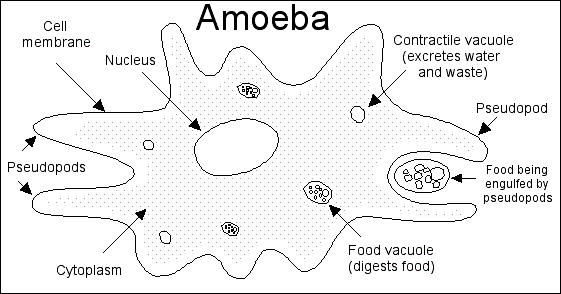
Structure of Ameoba sp.


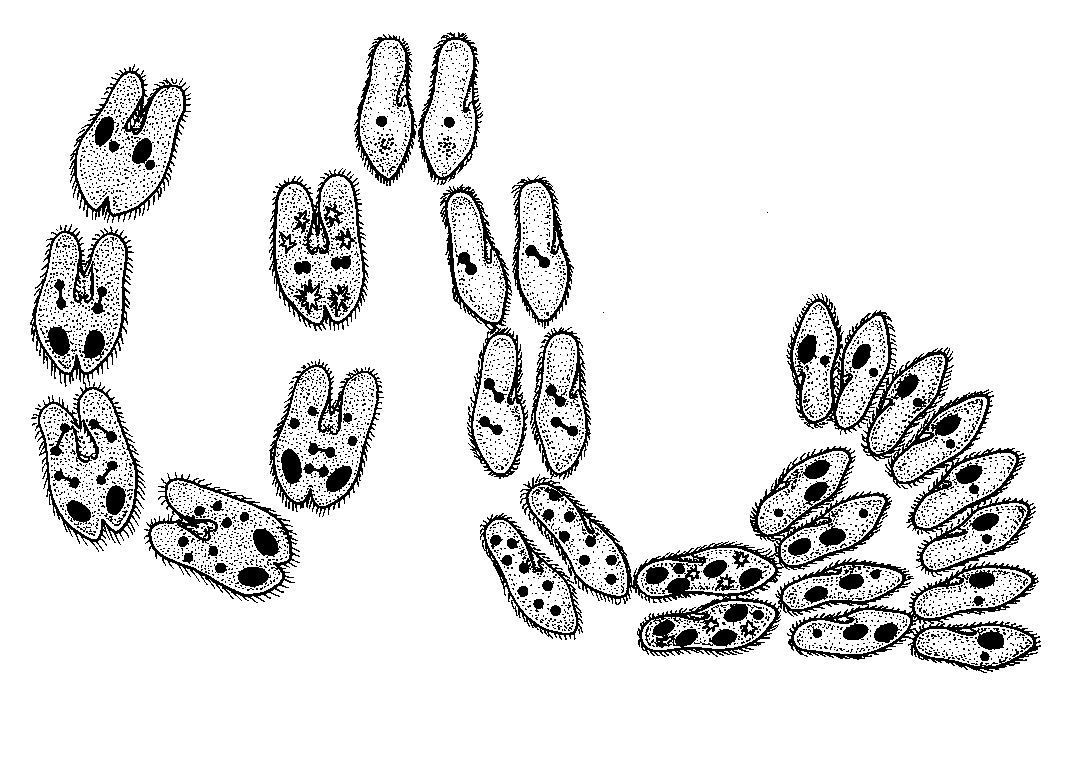
Structure of Paramecium sp.


Life processes carried out by unicellular organisms

1. Respiration
  • Exchange of gases (oxygen & carbon dioxide) occur through plasma membrane by simple diffusion (the transport of molecules across the plasma membrane down the concentration gradient through the phospholipid bilayer until equilibrium is reached) on the surface of cell.

2. Movement
  • Amoeba sp, moves using pseudopodium (false feet).
  • Paramecium sp. moves using rhythmic cilia beats.
Amoeba sp.
Amoeba sp.


3. Nutrition
  • Amoeba sp. moves towards food by extending its pseudopodium to trap food particles by phagocytosis.
  • Food vacuole combines with lysosome, food particles are hydrolyzed by the enzyme lysozyme in lysosomes. 
  • Nutrient are absorbed into cytoplasm.
  • Undigested food is discharged when Amoeba sp, moves
  • For Paramecium sp., cilium beat helps to transfer food particles into oral groove. Undigested food is discharged through anus.

4. Responding to stimuli
  • Respond to chemicals, touch or bright light by moving away from the stimuli.

5. Reproduction
  • Reproduce via binary fission (asexual reproduction) through mitosis when the conditions are suitable and have plenty of food.
  • Amoeba sp. forms spores when conditions are bad (dry, low temperature, food shortage)
  • For Paramecium sp., conjugation (sexual reproduction) occurs when conditions are bad
Amoeba binary fission
Binary fission


Paramecium conjugation
Paramecium sp.: Conjugation


6. Growth
  • Synthesize new cytoplasm.

7. Excretion
  • Waste (carbon dioxide, ammonia etc.) are removed by diffusion/
  • Water diffuse via osmosis.
  • Undergo osmoregulation = the process of maintenance of salt and water balance ( osmotic balance) across membranes within the body`s fluids

Similarities and differences between Amoeba sp. and Paramecium sp.


Friday, 5 February 2021

SPM Biology 2 Cell Biology & Organization Part 2 Cell Structure & Functions

Mitochondrion
Mitochondrion
Mitochondrion (Plural: Mitochondria)

  • Rod-shape / spherical
  • 2 layers of membranes
  • Functions: 
    • A site that generates energy


Centriole
Centriole
Centriole

  • Small cylindrical components that exist in pairs in animal cells, X in plant cells
  • Made up of microtubules 
  • Functions:
    • Forms spindle fiber during cell division


Golgi Apparatus
Golgi Apparatus

Golgi Apparatus

  • Stack of parallel flattened sacs, single cell membrane
  • Functions:
    • Processes, modifies, packs and transports chemicals (protein, carbohydrate etc.)


Plasma Membrane

  • Plasma Membrane
    Plasma Membrane
    Outer membrane that surrounds the cell
  • Made of proteins & phospholipids
  • Thin, elastic
  • Functions:
    • Controls movement of substances into & out of the cell
    • Separates content of cell from external environment
    • Allows exchange of nutrients, gases and waste materials between cells & their surroundings


Lysosome
Lysosome
Lysosome

  • Small spherical sac, single membrane
  • Contains hydrolytic enzymes
  • Functions:
    • Hydrolyses complex organic molecules (protein, nucleic acid & lipid)
    • Breaks down bacteria, damaged cells


Nucleus
Nucleus
Nucleus (Plural: Nuclei)

  • Largest component in the cell
  • Spherical, enclosed in nuclear membrane with many pores
  • Double membrane
  • Contains chromosomes, nucleolus and nucleoplasm 
  • Functions:
    • Controls all cell activities
    • Chromosomes contain deoxyribonucleic acid (DNA)

Ribosome
Ribosome
Ribosome

  • Small, compact, spherical granules
  • Consists protein and ribonucleic acid (RNA)
  • Present on the surface of rough endoplasmic reticulum / freely exist in cytoplasm
  • Function:
    • Site for protein synthesis


RER & SER
RER & SER
Endoplasmic Reticulum (ER)

  • Folded flattened sacs
  • Two types of ER
    • Rough ER: has ribosomes attached on the surface
    • Smooth ER: X ribosomes
  • Functions:
    • Act as transport system within the cell
    • RER transports proteins synthesized by ribosomes
    • SER synthesizes & transports glycerol and lipids, detoxify drugs and metabolic by-products 

Cytoplasm
Cytoplasm
Vacuole
Vacuole

Cytoplasm 

  • Jelly-like medium that contains the components of cells
  • Contain organic (protein, carbohydrate etc.) & inorganic (potassium ions) compounds 
  • Functions:
    • Medium for biochemical reactions in cells


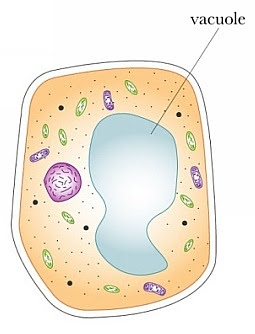
Vacuole

  • Liquid-filled sac, the liquid called cell sap
  • Surrounded by tonoplast
  • Exist in plant cells
  • Small size in unicellular animals 
  • Functions:
    • Water is absorbed into the vacuole and the plant cell becomes turgid
    • In unicellular animals, vacuole contracts during osmoregulation, osmosis and excretion


Chloroplast
Chloroplast
Chloroplast

  • Oval shaped
  • 2 layers of membrane
  • Contains chlorophyll
  • Functions:
    • Chlorophyll absorbs sunlight during photosynthesis


Cell Wall 

Cell Wall
Cell Wall 

  • Strong and rigid outer layer of plant cells
  • Made from cellulose fiber
  • Fully permeable
  • Functions:
    • Maintains the shape of plant cells
    • Provides mechanical support to plant cells


Thursday, 4 February 2021

SPM Biology 2 Cell Biology & Organization Part 1 Types of Cells

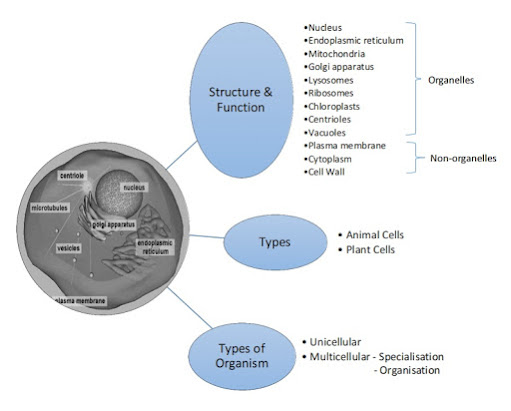
Mind Map

Summary of Chapter 2 Cell Structure and Cell Organization
Summary of Chapter 2 Cell Structure and Cell Organization 


Cell 

  • Cell is the basic unit of life and is functioned to carry out the life processes. 
  • It exists in various shapes and sizes. 
  • It is made up of plasma membrane which contains protoplasm (cytoplasm and nucleus).
  • The function of cell is to carry out the life processes. 

There are 2 types of cell:


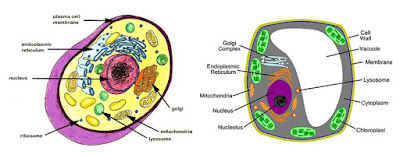
Animal and plant cell
Animal cell                             Plant cell 


Table below shows the similarities and differences between animal cell and plant cell:

similarities and differences between animal cell and plant cell


** density of organelles (specialized structures which are each surrounded by its own membrane & perform specific functions) in a cell depend on the type of cell and its function**

e.g. cells that are active have many mitochondria to provide enough energy for its activities:-
  • Sperm cell
  • Muscle cell
  • Meristem cell
e.g. cells that have many chloroplast for photosynthesis:-
  • Mesophyll cells
  • Guard cells