Showing posts with label amino acids. Show all posts

Friday, 26 March 2021

STPM Biology Biological Molecules Part 16 Amino Acids - Properties of Protein

1. Protein is amphoteric.

  • Its structure has basic and acidic group.
  • Amino group, NH2 is basic; while carboxyl group, COOH is acidic.

Structure of amino acid

2. Protein is an important buffer in biological systems.

  • The amphoteric nature of protein allows it to function as a buffer.
  • Amino groups of protein removes excess acids in the system.
  • Carboxyl groups neutralize the excess bases in the system.

Protein as buffer in biological system

3. The colloidal nature of proteins allow it to exist as individual molecules in solution.

  • Colloids are particles not soluble in water but remain suspended in the solution.
  • Colloidal particles are usually 1nm to 100nm in diameter.
  • Most globular proteins are soluble in water due to the small size of its molecule and existing polar groups such as -COOH.
  • Globular protein with larger molecules will from colloidal suspensions in water.
  • The colloidal nature of protein provides a larger surface are for biochemical reactions in cells.

Differences between solution, colloidal solution and suspensions

4. Protein denaturation.

  • The change of structure and shape of the protein molecule due to the breaking down one or more bonds maintaining the structure of protein molecule is called protein denaturation.
  • It can be caused by acids, bases, heat, pH and ultraviolet light.

Protein denaturation

STPM Biology Biological Molecules Part 15 Amino Acids - Levels and Composition of Protein Structure

Levels of protein structure

1. Primary structure

  • Primary structure is structure showing the number and sequence of amino acids in its molecule.

Primary structure of insulin

2. Secondary structure

  • Secondary structure is the structure showing the coiling of polypeptides to become helix or the folding of polypeptide to become pleated-sheet.
  • Secondary structures are maintained and stabilized by hydrogen bonds.

Secondary structure of protein

3. Tertiary structure

  • Tertiary structure of protein is the structures showing how a single polypeptide chain (helix) is folded form a globular structure.
  • This structure is maintained by various bonds; among which are disulphide bonds, electrovalent bonds or hydrogen bonds.
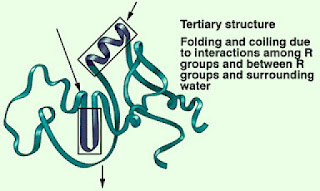
Tertiary structure of protein

4. Quaternary structure

  • Quaternary structures of protein is the structure showing how two or more polypeptide chains are bound together.
  • Examples of protein with quaternary structure are hemoglobin.


Quaternary structure of protein


Four levels of protein structure


Composition and structures of protein

1. Proteins can be classified according to its composition or structure.

2. Based on composition, proteins can be grouped into:

  • simple protein
  • conjugated protein

3. Based on structure, proteins can be divided into:

  • Fibrous protein
  • globular protein


Simple protein

  • Proteins that contain amino acids only.
  • For examples: albumin, globulin, and histone.


Conjugated protein

  • Protein bounds to non-protein groups.
  • Non-protein groups which bound to proteins are known as prosthetic groups.
  • For example: hemoglobin.

Structure of hemoglobin
Structure of hemoglobin

Fibrous protein

(a) Fibrous protein consists of long and parallel polypeptide chains.

(b) The polypeptide chain in fibrous protein is usually coiled to form α-helix.

(c) Neighboring helical chains are usually cross-linked by hydrogen bonds, electrovalent bonds, or disulphide bonds.

(d) Fibrous protein are not soluble in water and are very strong.

(e) Examples of fibrous protein:

  • Collagen - in tendons, cartilages, bones and skin.
  • Myosin - structural protein in muscles.
  • Keratin - structural protein in hairs, nails, feathers and horns.
  • Elastin - found in ligaments.
  • Sclerotin - combines with chitin to form the exoskeleton of insects.

(f) Collagen is the most common protein in mammals.

  • This protein is a main structural component of connective tissues (cartilage, skin, tendons and ligaments).
  • The basic structure of collagen is a tropocollagen helix which consists of three polypeptide chains (helixes) twisted together.
  • The chains are stabilized by hydrogen bonds between the protein chains.

Collagen fiber
Collagen fiber


Globular protein

(a) In globular proteins, the polypeptides (helixes) are folded into globular structures.

(b) The globular structure is maintained and stabilized by hydrogen bonds, disulphide bonds and electrovalent bonds.

(c) Some globular proteins are soluble in water; some of them form suspension, and the rest are insoluble in water.

(d) Globular proteins are easily denatured. This is because the hydrogen bonds and disulphide bond in the molecule can easily be broken.

Denaturation of protein


(e) Examples of globular protein:

  • Hemoglobin
  • Myoglobin
  • Hormones
  • Enzymes

Wednesday, 10 March 2021

STPM Biology Biological Molecules Part 13 Amino Acids

1. Protein is an organic compound consisting of carbon, hydrogen, oxygen, nitrogen and sometimes sulphur and phosphorus.

2. Protein is a natural polymer, the monomer of protein is amino acid.

3. The basic structure of amino acid:

Basic structure of amino acid

4. Amino acid has a basic amino group, -NH2 and a acidic carboxyl group, -COOH and a side chain, R. There are 20 types of amino acids found in proteins. Different amino acids have different R chain.

Amino Acids
Three Letter Abbreviation
Alanine
Ala
Arginine
Arg
Asparagine
Asn
Aspartic acid
Asp
Cysteine
Cys
Glutamine
Gln
Glutamic acid
Glu
Glycine
Gly
Histidine
His
Isoleucine
Ile
Leucine
Leu
Lysine
Lys
Methionine
Met
Phenylalanine
Phe
Proline
Pro
Serine
Ser
Threonine
Thr
Tryptophan
Trp
Tyrosine
Tyr
Valine
Val


5. Amino acids can be classified into 4 major types based on the side chain (R).

  • Non-polar amino acids
  • Polar amino acids
  • Basic amino acids
  • Acidic amino acids


Non-polar amino acids

  • Non-polar amino acids are amino acids with a non-polar side chain
  • Examples: glycine, alanine, valine, leucine, methionine, isoleucine, phenylalanine, and tryptophan.
Non-polar amino acids


Polar amino acids

  • Polar amino acids are amino acids with a polar side group.
  • Examples: serine, threonine, asparagine, glutamine, tyrosine, and cysteine.
    Polar amino acids
    Polar amino acids


Basic amino acids

  • Basic amino acids have side chain which is an amino group, NH2, a base group. 
  • Examples: lysine, arginine, and histidine.

Basic amino acids
Basic amino acids


Acidic amino acids

  • Acidic amino acids have a side chain which is a carboxylic group, COOH.
  • Examples: aspartic acid and glutamic acid.
Acidic amino acids
Acidic amino acids